Physical Address
304 North Cardinal St.
Dorchester Center, MA 02124
Physical Address
304 North Cardinal St.
Dorchester Center, MA 02124

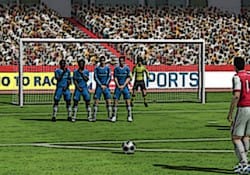
Set pieces in football are planned sets of runs that happen during either a free kick, or a corner kick. These pre-arranged runs enable maximum space coverage and opportunities that can result in high-quality goal scoring opportunities. The one thing that you will realize from majority of the set pieces mentioned below is that the runs will practically always end up in the same regions to capitalize on openings in the danger zones for defending teams.
According to most research studies, up to 40% of team goals are scored from set plays. Hence, if your team does not get around 40% of its goals from its set plays, imagine the number of opportunities that your team may receive if it also opts to capitalize nearly on that rate.
Type of set pieces in football:
These are some of the most important set pieces for the offense team. It’s a free opportunity to kick the ball into the penalty region close to the goal post and try heading it in. Teams that frequently get corner kicks try to increase their odds of hitting the incoming ball in midair by getting all their tallest players in the penalty box.
Since defenders are normally the tallest players, this often infers that some defenders come in to contest for the ball while the shorter offensive players replace them in their positions. Although this gives the defense players some fun and improves the team’s odds of scoring, it leaves them vulnerable to quick counter-attacks as all their defensive players are deep into the opponent’s goal post trying to score.
At times, the team taking the corner may opt to play a “short corner”. As opposed to kicking the ball to the penalty region, one of the offensive team player will sprint towards the corner for a pass from the teammate taking the corner. This tactic is usually meant to create more favorable angles of crossing the ball, as opposed to not crossing it or just crossing it.
The usual set piece of taking a goal kick, mostly by the goal-keeper (kicking the ball back in play from the goal box) is not considered important or interesting in high-level amateur or professional plays. Goalkeepers can easily and accurately pass the ball to one of the defensive player or shoot it halfway-down the field to one of the offensive player. The goal kick in youth soccer is a bit more exciting as kids usually can’t kick the ball as well or as far.
This play is really exciting as it’s the one moment that non-goalie soccer players use their hands to play the ball. Most throw-ins are a quick exercise of maintaining possession. Normally, the player throwing in the ball will try to find an open teammate or one running towards him/her and throw him/her the ball. The individual may then quickly tap back the ball to the thrower who’s then at liberty to do as he pleases.
Throw-ins are simply meant to get the ball back to play and your team possession. In the event that the ball is thrown in close to the goal post, the team in possession is trying to score. This usually occurs when the ball gets out of play close to where a corner kick is taken. They may opt to handle the set play like a corner that simply needs to be thrown in rather than kicked. Usually, there’s one person on every team who can make “long throws” and send the ball to penalty box with as much speed as possible.
Note that there are rules on how to throw the ball: both feet must be flat on the ground when throwing the ball. In addition, the player should hold the ball with two hands, which should move in parallel so as to avoid giving the ball a tricky spin.
During a foul play, a free kick is normally a quick deal especially if the foul was committed far away from the target goalpost. Simple ball possession is worth more compared to the opportunity to kick it a long way without guarding it. Thus, teams awarded free kicks close to their goalpost or in their own half simply pass it to amongst themselves thereby maintaining possession.
Free kicks awarded anywhere in the third of the offensive goal is a very important moment in the whole game. Teams awarded such free kicks usually take their time before executing it. Meanwhile, defensive teams attempt to counter this by organizing themselves. Some of the defenders will try to prevent the offensive players from getting to the end of the free kick pass, whilst others line themselves in a wall ten yards in front of the ball to avoid an easy shot.
There are two types of free kicks: indirect and direct. Direct kicks are the most common and bare no restriction as to what the offensive teams should do with them. On the other hand, indirect kicks are awarded for less serious offenses that break a technical rule instead of a safety rule.
This is a special kind of set piece. It is awarded when a foul that otherwise would lead to a free kick is committed within the penalty region. It is an extraordinarily valuable play and unlike the other plays in the game, 85% of these kicks lead to goals. A penalty kick is nothing like other set pieces in soccer, that most people tend not to consider it a set piece.
It is utilized to restart a play in the event the referee stops the game for a reason not listed. None of the competing team is usually awarded the play and offers no advantages to any side. In most situations, this play is awarded in the event the ball becomes deflated or a players lies injured in the field. The ball is usually dropped in the middle of the two players and none is expected to touch it until it touches the ground. Otherwise, repeat touches by the same player before it touches the ground would results in the player being yellow carded.
It is not a common play in the modern soccer and the players concerned usually agree on whom to take it. Normally, the player taking it may opt to shoot it to the opponent’s goalpost. However, shooting it out close to the opponent’s goalpost to warrant a throw ball to the opponents is normally considered ideal, as the offensive players get to position themselves in the half of the defending team, to increase their odds of repossessing the balls and scoring.