Physical Address
304 North Cardinal St.
Dorchester Center, MA 02124
Physical Address
304 North Cardinal St.
Dorchester Center, MA 02124

If football is all about scoring goals, football managers would pack the field with eleven strikers. However, the game is much more complex and managers have to use certain formations to win games. Over the last 90 years, different formations have been developed. Below is are a number of Modern and tactical football formations and how they vary from each other.
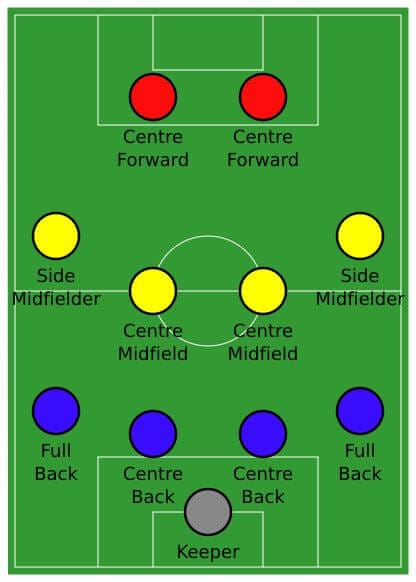
The 4-4-2 is arguably the most popular formation with football managers today. Using this formation the team is set up as follows: there are four defensive minded players, two of them playing as central defenders and the other two as wing backs. In front of them are four midfielders, two of whom play in central midfield and are flanked by the two wingers. The two strikers lie ready in wait to attack. 4-4-2 formation is favored because it provides the midfield with strength, width and depth.

This formation may take two variations. Either, the four midfielders can form a flat line across the midfield otherwise known as the flat four. Alternatively, one of the central midfielders is assigned defensive role freeing the other central midfielder to support the attackers. The other two midfielders play on the wings forming a diamond formation. From time to time, the two central midfielders may alternate roles further confusing the opponent.
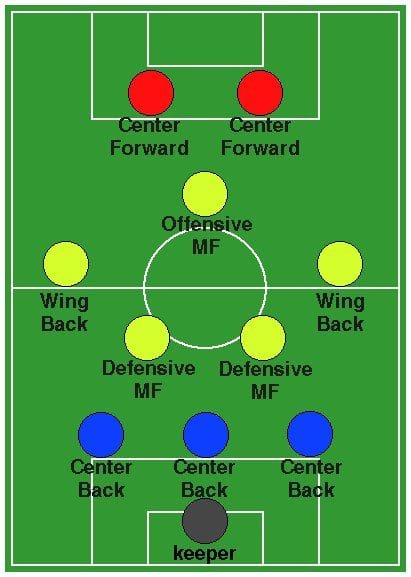
This formation was used expertly used by Luis van Gaal’s Dutch team to knock the defending champions Spain out of the 2014 tournament in Brazil. It is used by teams with inferior defensive abilities against strong and attack minded opposition. All the three defenders play as central defenders, one of them acting as a sweeper. In front of the defenders are five midfielders, two of whom play in the wings. These two are natural wing backs and run the full length of the pitch to supply crosses to the two strikers. When this happens the teams assumes a 3-5-2 formation and reverts to the 5-3-2 when the wing-backs track back to defend. Thus, the wings-backs must be fit, pacey and very mobile. Retired Brazilian players Cafu and Roberto Carlos modeled this role expertly. The other three midfielders play a more central role supporting the defense and attack.
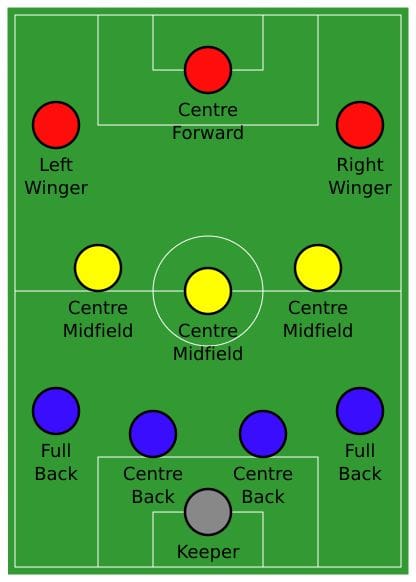
The success of this formation is based on the ability of the three midfielders to form an organized and coordinated unit. The three, who occupy the traditional positions 6, 8 and 10, must move as a unit within the midfield if the formation is to be effective. This curtails opposition attack by slowing its midfield movement.
The four defenders’ role is to defend as attacking is primarily left to the three attackers one of whom acts as a central striker. The other two attackers flank him and also double up as wingers. They provide the width needed to unlock the opposition’s defense from the wings. This has been used effectively by Chelsea under Jose Mourinho in 2007 as well as Pep Guardiola’s much feared Barcelona team. The formation is best suited for possession based passing football.
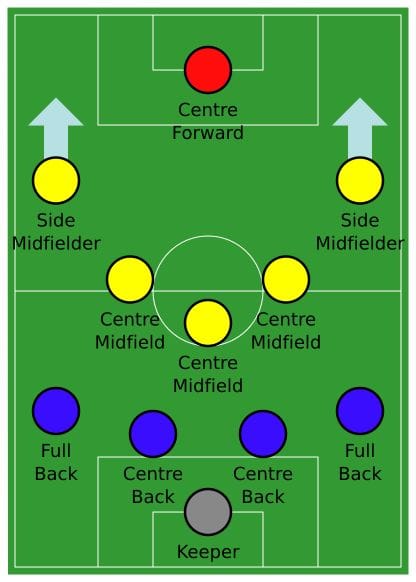
Most people confuse the 4-5-1 with the 4-3-3 formation but is quite different. 4-5-1 consists of four defenders, a strong midfield comprising of five players and a lone striker. Managers use it when playing tough away matches, when preserving a slender lead or when playing for a draw. Like the 4-3-3 formation, it uses three central midfielders with one of them playing in front of the back four. The fourth and the fifth midfielders play on the wings and supply crosses to the lone striker.
This system packs the midfield with many players thus providing adequate cover for the four man strong defense. Isolating the lone striker is its main weakness. A strong pacey striker like Chelsea’s Didier Drogba, whose ball holding skills enable the midfielders time to provide support, is favored. At Chelsea, Jose Mourinho’s excellent game management skills allow him to combine the 4-5-1 and the 4-3-3 masterfully as the game progresses.
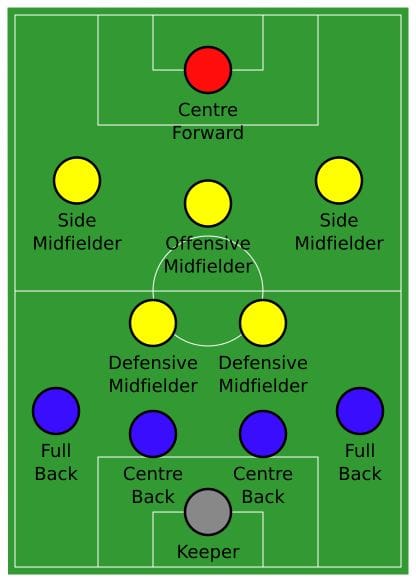
The 4-2-3-1 formation is a bit complex and flexible as it provides four layers of players along the field. The first layer consists of two central defenders and two wing backs. The wing-backs can surge forward to support attack, further pinning the opposition backward.
The second layer consists of two defensive midfielders one of whom provides the tackles and the other distributes the ball forward. These two players control the pace of the game and must be very intelligent as they have to alternate the tackling and distribution roles without exposing the back four.
The third layer comprises three attacking midfielders. One of them is the play-maker flanked by two wingers. The three work together to supply the ball to the lone striker, who must be a excellent finisher. Under Rafael Benitez, Valencia used Pablo Aimar as a play-maker and won the La Liga in 2002. This system is favored because it allows the team to transition quickly from defense to attack.
Catenaccio, also known as door bolt, is one of the modern football formations. It has gradually become obsolete as teams sought more offensive options. It relied on astute defending, which is similar to putting a door bolt on a team’s goal thus nullifying the opposition’s attack. The system depends on the libero; a player given much freedom to roam the pitch, but whose primary position is between the goalkeeper and the back four.
The work of the libero was to clear loose balls as well as tackle any opposition player who broke through the back line. Under Catenaccio, teams used 1-4-4-1 and 1-4-3-2 to counterattack, score quick goals and then close out the game. While counterattacking, one of the back fours would surge forward to support the attackers. The rise of Total Football marked the death Catenaccio.
Total Football was developed to counter the “anti-football” Catenaccio tactics. It was founded on utility, positioning and coordination of players. Any player, apart from the goalkeeper, could play any role on the pitch. A player who moved out of a position was covered by another player. As such, a defender could surge forward and attack without jeopardizing the team’s defensive positions. Possessing the ball, pressing high up the field and accurate passing were fundamental tenets of Total Football. However, its purest form has become untenable due to lack of versatile and utility players. Modern versions such as the ‘tiki-taka’ have replaced it.
The contemporary game demands a more pragmatic approach. None of the modern and tactical football formations guarantees success to any team in successive games. Therefore, football managers tinker with formations depending on the opposition and the players available.